
Image credit: Georges Seurat: A Sunday Afternoon on the Island of La Grande Jatte
Theology is a human construct trying to understand God from the human’s perspective, rather than the divine revelation from God. Even though the word “theology” came from Greek θεός (theos - God) and λόγος (logos - word, reasoning), it really means to reason “around (περί)” God, rather than word “out of (ἐκ)” God.
This is why historically, heresies grew out of theological studies, some even earnest. Avoiding heresies is a complex affair: there are more than 50 -isms and -ians in the List of Christian heresies. Even though most heresies are universally dispelled by mainline Christianity, the mainline Christian denominations are split partly over differences in theology and tradition. See the List of Christian denominations and Denomination Differences.
Sound theology should be based on a justifiable understanding of the Bible, but manmade theories are incomplete samplings that only give you an approximation of the complete picture.
You can picture theology like a Pointillism painting.
Image credit: Georges
Seurat: A Sunday Afternoon on the Island of La Grande Jatte
Or perhaps recreating a painting of Mona Lisa using paintballs.
Source: NVIDIA:
Adam and Jamie explain parallel processing on GPU’s
A concrete example is to picture the Father, the Son, and the Holy Spirit in Trinity.
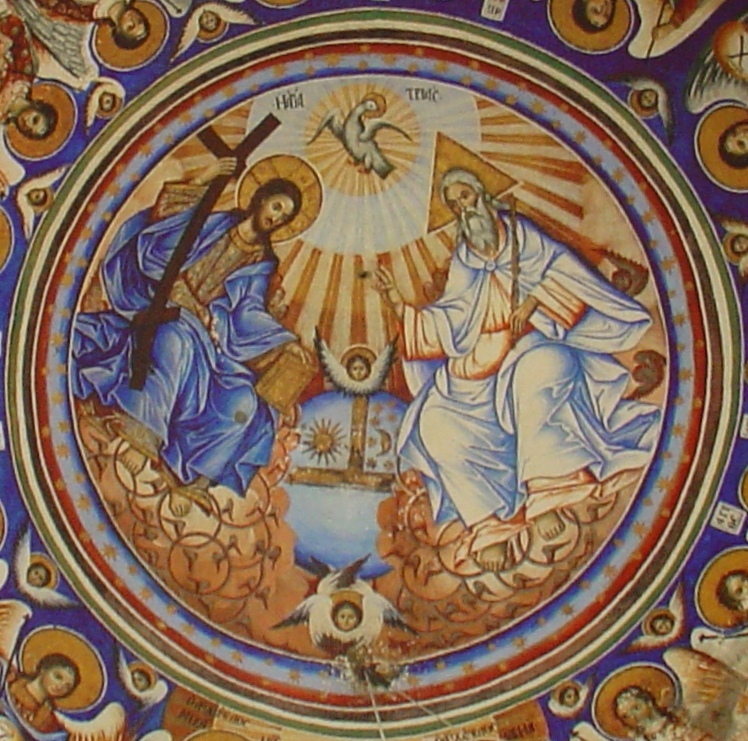
Image credit: H
Agia Triada Moni Vatopediou Agion Oros
Although the concept of Trinity is biblically justifiable (even mathematically justifiable, see Trinitarian Arithmetics), we understand that this is not exactly what the Father looks like, nor the Son. The Holy Spirit, or πνεῦμα (penuma - breadth or wind) ἅγιος (hagios - holy), appeared as tongues of fire (Acts 2:3) but here depicted as a dove (John 1:32).
No picture is completely correct, nor any theology, even if they are justifiable scripturally. The fallacy follows when you try to extrapolate from the theology to derive new teachings.
However, the greatest danger of indulging in theological studies is forgetting how you and I fit into this picture. We are not just trying to understand God as a specimen. The ultimate purpose should be to understand how we relate to God. Because “God so loved the world, that he gave his only Son, that whoever believes in him should not perish but have eternal life” (John 3:16), we are to “love the Lord your God with all your heart and with all your soul and with all your mind” and “Love your neighbor as yourself” (Matthew 22:37-40). And to “encourage one another and build one another up” (1 Thessalonians 5:11) as we fulfill the great commission:
Go therefore and make disciples of all nations, baptizing them in the name of the Father and of the Son and of the Holy Spirit, teaching them to observe all that I have commanded you. And behold, I am with you always, to the end of the age. (Matthew 28:19-20)
As Jesus promised.

